No ads, no data, no growth hacks: how a team of four built an app 7.5 million people open every day
 Share
 Share
 Share
Z Venture Capital (ZVC) has invested in New chat, the company behind Setlog. Once an hour, Setlog users capture a moment of their day and share it with friends. The app has spread rapidly among young people in Japan and Korea, reaching the No. 1 spot on Japan's App Store rankings.
Services like this are often dismissed as passing fads, but we see Setlog as a product that creates a daily habit. Why do users care about Setlog this much? Kinuko Kitabatake of ZVC, who led this investment, sat down with founder and former Snap designer Devin Doty to talk about the choice not to collect user data, the day a UI change set off a firestorm, how a team of just four people works with AI, and the coming challenge in the US.
In conversation
Devin Doty(New Chat CEO)/ Kinuko Kitabatake(Z Venture Capital)
From Snap to Setlog: building the product he wanted for himself
Kinuko: Devin, it's been a while! Good to see you. It feels like Setlog is shipping updates and new features almost every day now. You must be super busy?
Devin: Yeah, we have a lot of new stuff coming out this month (October) too, so it's been pretty busy, but I'm excited to see how users react.
Kinuko: I want to hear all about that too. First, how's the recent traction been?
Devin: Pretty consistent. The daily figure I look at is the number of people who open the app each day. In August that was around 6.5 million, and in September around 7.5 million. Lately we've been growing by about a million people a month.
Kinuko: Wow, that's really cool. Is that mostly Japan for now?
Devin: Yes. We recently started a trial in the US as well, but Japan is by far our biggest market right now.
Kinuko: The growth in Japan has really been explosive. One of the things I wanted to ask you about today is whether Setlog is just a one-time boom, or whether it's actually creating a new kind of habit. Obviously we invested because we believe it's a product that will stick around for the long term, and I'm hoping we can go deeper than what Japanese readers already know.
Devin: That's exactly how we think about it too, as a long-term, sticky product.
Kinuko: I cover consumer investments out of ZVC's San Francisco office. With generative AI content and AI apps everywhere now, I think younger users especially are coming back to wanting something real, something that actually means something to them. And I feel like Setlog fits right into that.
Devin: It's great to hear you say that. As for how Setlog started, there are a lot of different pieces. I was at Snapchat for a long time, I worked at Tumblr, and I tried to build two companies in the past. As a designer, I'm interested in many different things. Ideally, I'd love to make furniture.
Kinuko: Really?
Devin: But I get this strong intuition of "this makes so much sense and no one's working on it, so maybe I should tackle it." During my time at Snapchat, I saw their struggles up close and learned so much from their mistakes. At the same time, I truly believed in the core product. All of that led me toward Setlog.
And then I noticed, "Wait, Japan doesn't really have this type of product." Snapchat never took hold in Japan, and that was always interesting to me. Snapchat just didn't put much effort into the Japanese market. I made a note to myself: "This is interesting. Maybe one day that could be a play."
Kinuko: It's really interesting that that note led to where you are now. Some people reading this are probably like, "So what is Setlog, exactly?" People call it social media or a vlog app, but you describe it as visual communication. What does visual communication mean to you, and how would you describe Setlog in the first place?
Devin: Good question. What we call Setlog internally is "continuous presence." Throughout your day, you feel like you're with this person even though you're not. That's what we're trying to bring to the rest of the app. It's about using videos and photos to convey the kind of information you'd otherwise have to write out at length in text.
When I first started communicating with photos and videos, not just traditional messaging, I felt the distance to that person shrink all at once. You see things you would never see otherwise, like what their office looks like, or what their pet looks like. The closeness felt like a whole different level. So for me, Setlog is continuous presence with the people you're close to, built on a foundation of visual communication through photos and videos.
Kinuko: As a user, I really feel that. This summer I traveled with friends and we all used Setlog together, and it was so much fun. It started really naturally. At first I was only using it with my husband. I wasn't trying to promote it to my friends, but they were like, "Let us in too," and then we all used it. What I noticed is that it doesn't take over your attention.
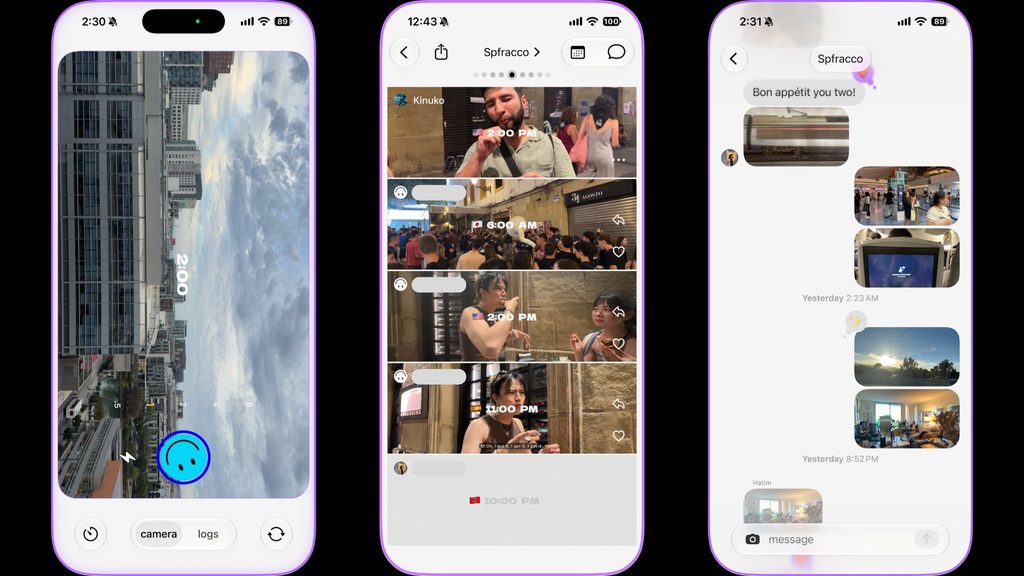
Setlog’s Camera, Posting, and Chat Features
With other social apps, when you post a video, you can get really anxious about how many people watched it or what people are saying about it. What's great about Setlog is that I didn't think about it at all after posting. There's no need to edit anything, you just capture the moment, and when you're busy or present in the moment, you don't even look at it. Then on the way home from the trip, we all looked back through it together, like, "We had such a fun time."
Devin: I love that.
Kinuko: And you said before that you want Setlog to be like a camera roll you'd want to go back and look through. I really resonated with that. When you use Setlog on a group trip, you get to see yourself through other people's eyes. I thought that was so new and special.
Devin: I don't want to give it away, but we have something interesting coming in that area too. Keep an eye on our upcoming updates.
An hourly ritual, made by users
Kinuko: I also want to ask about the posting cadence. BeReal is once a day, but Setlog is once an hour, and you can skip hours. With hourly posting, it doesn't have to be some special moment. It can be a truly ordinary one. What was the thinking behind the one hour, and behind making Setlog the way it is?
Devin: With the hour, we've actually tried to ease up on it and make it more free. But there's a pull from both sides. Some people say, "Give me the notification every hour, I will do it every single hour." Others say, "I don't want this, let me do it when I want to." It's hard to accommodate both.
The hourly mechanic comes from the earliest version of Setlog. It was derived from what users were already doing on Instagram. We thought of it as our initial hook into the market: build the hourly product, users post what they make onto Instagram, and you get this flywheel of organic distribution. More than six months in, the hourly cadence and the notifications are still there. Whenever we've tried to ease up on it, users genuinely take offense. "That is the core of the product. Don't ever change it." It's like trying to change the 24-hour story on Instagram. At this point, it's the foundation.
What's interesting is that Setlog itself was derived from behavior users came up with. We just made a product that makes it easier. So I can't claim we invented the one-hour thing. We're navigating what matters together with our users. That said, I do think the future of the app has ways to be a little more free from the one hour. I'm excited to get that out.
Kinuko: That's such an interesting point. There's this balance between what users want and what you believe is the DNA of the product. As a founder, do you chase PMF (product-market fit), or do you build what you believe in? I think that's a really hard question. How do you balance it?
Devin: I feel like that's one of the hardest things. We recently ran a study on a college campus and got the results back. It touched on something we're building, and some people said they wouldn't use it while others said they would. Even with that feedback, it's hard to discern.
But for me, the axis is still fundamental human values. If you receive a photo from somebody you're close with, it simply makes you happy. I think that's fundamentally human. So most of what we drive toward is that fundamental closeness.
Of course, we've stumbled along the way. Early on, we did a redesign that users truly hated, and we got a flood of one-star reviews. What that told us is that people think of Setlog in a specific way: "Setlog is once an hour, one at a time." At that point, we stamped it in the book: we're not touching that again.
The Day One-Star Reviews Poured In: Devin’s Decision
Kinuko: When you changed the UI to fit more people in a group, it kind of blew up on social media too. I was seeing so many posts from what looked like high school or junior high school kids who were so mad about the UI change. We were actually right in the middle of due diligence at the time, and I remember thinking, for a casual high school girl to be that upset about a UI change really shows how much the app has become their daily thing, something they really treasure. What was happening inside the team that day? How did you make the decisions?
Devin: Actually, you were one of the first people to message me about it, so I remember it clearly. You even followed up afterward and said, "Good job rolling it back," which was a relief. On my phone, I get notifications for reviews: one star, five stars. We started getting a ton of one-star reviews. I also personally receive support emails. Normally it's around 50 a day from users; during that period, I think we got thousands. It was an unmistakably clear signal: "We don't want this."
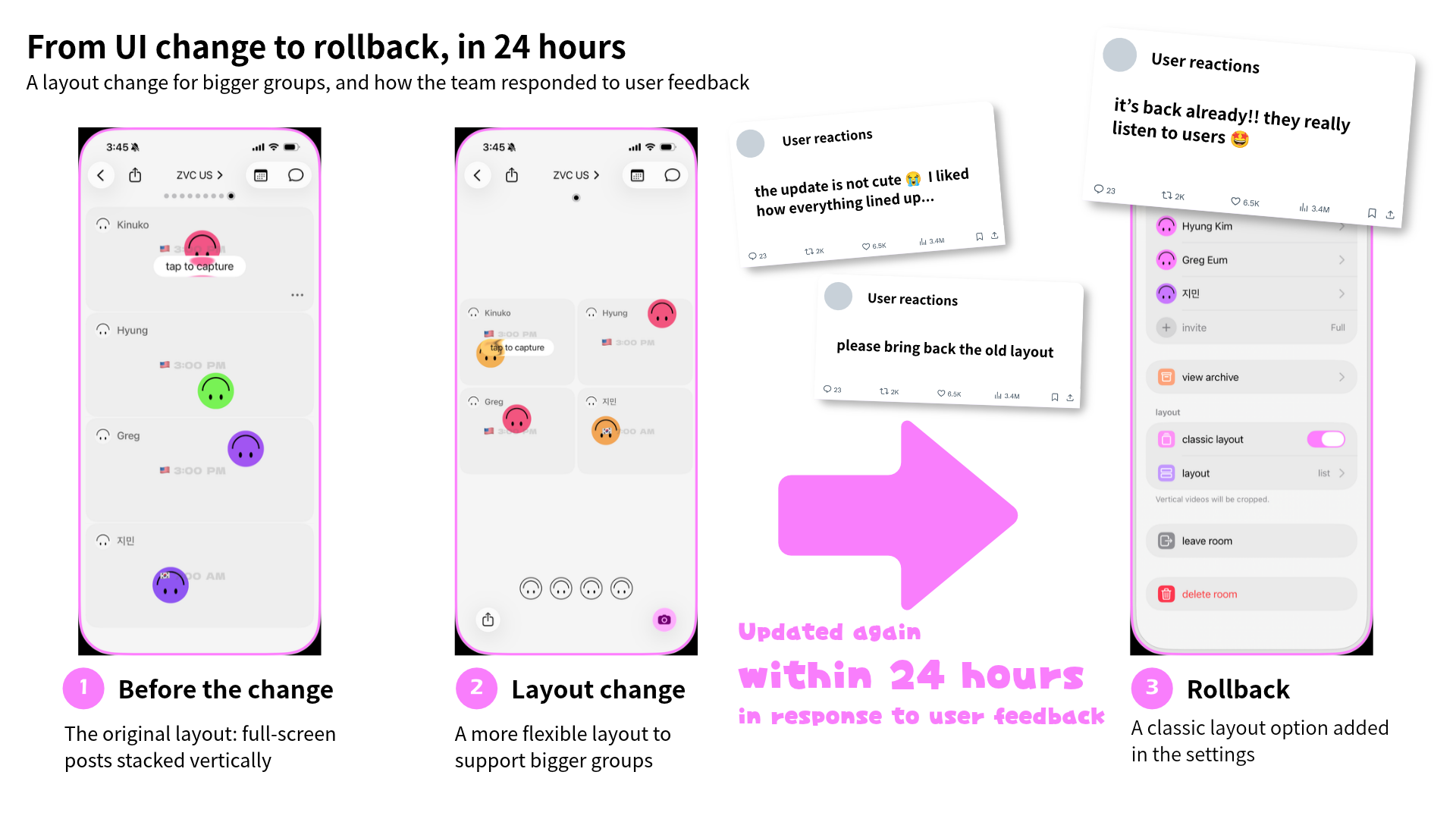
*The post-change UI shown is the current version (October 2026) and differs slightly from the July release.
It was probably the most stressful period in the history of this product. The servers have gone down from capacity a few times, but the UI change was the hardest. Rolling it back, shipping it, replying to emails, telling everyone it would go back to the way it was. I don't think I slept for about two days.
We couldn't see it in the moment, but our users are genuinely passionate about this product, they truly care about it, and they use it every day. It was a clear signal that we have users who really matter to us.
Kinuko: And you put the UI back right away. That speed was so well received. Posts like "the UI is back" went viral, and everyone kept reposting and reacting. I think users felt like, "They actually listen to our voice." Compared to other apps, that really stood out. And at the time, nobody knew that an app as big as Setlog was run by a team of three or four people. That fast feedback was really appreciated.
Devin: We still get that in our App Store reviews: "This team fixes things really fast, thank you." We use AI to go all in with a small team. But I think this is going to become more and more common. Even today, the number of products shipped per day that I see on X is far beyond a year or two ago. The amount of new things happening every single day is almost overwhelming.
Kinuko: Especially in the US, things are moving at a crazy pace every day.
Devin: Even as AI does more and more of the work, everyone here is working harder than ever, as if to keep up with it.
Kinuko: And you're right at the front of that yourself.
Devin: I think it's because the drive to progress and make things better is in our nature. Maybe I have a heightened version of it. I wake up every morning constantly wanting to make things better, to push things forward. There is stress. But it's also deeply rewarding.
The harder path: taking nothing from users
Kinuko: You’ve always been very clear about keeping Setlog a safe place for users. There’s no personal data collection, no contact graph upload for growth loops, not even basic demographics.
Honestly, that made our due diligence harder [laughs]. That's exactly the data most companies go after for growth, and you're deliberately giving it up. But I think that choice is what makes Setlog a space where users feel safe posting as they really are. What's the thinking behind it?
Devin: Good question. At the root of it, we are building a product that we would want to use. I grew up surrounded by products that are constantly trying to collect data. To protect yourself, you have to opt out, or dig through privacy settings to stop what they're taking.
So when we started Setlog, we first asked, "What would we want this app to see about us? What would we want it to take?" The answer was "nothing." I wanted a product I could hand to my friends and family and say, "You can use this and feel comfortable."
The other reason was our launch in Korea. If we caused a data privacy problem in that market, I think that alone would have ended us. So we were thorough about this from before release.
And there's one more thing: this company has a mindset of deliberately choosing the hard path, because that's where the better outcome is.
Take a map app, for example. You could probably make money by showing a five-second ad at launch. But users want to see the map as fast as possible. The genuinely hard thing is to generate revenue another way without degrading the user's experience. At Setlog, we want to keep choosing the harder path wherever we can. I believe that's what makes a stronger product that people use for a long time.
Kinuko: I really resonate with that. I don't think there's a user who goes, "I use this app because it's encrypted." But your philosophy shows up in the details of the product, and I think users pick up on those details intuitively.
They can't quite say what it is, but it feels safe, or it feels different from the apps they're used to.
At the same time, as social apps get bigger, they tend to become places where you worry about how other people see you, and relationships start to feel like a burden. In Japan, Setlog gets compared to BeReal a lot. How do you think about these problems with social apps?
Devin: In my mind, there's a clear line between Setlog and traditional social media. The structure of the product is different at its foundation.
I think we're actually closer to Discord.
In Discord, there are rooms where you can relax with people who share your hobbies, and rooms for mingling with strangers. Setlog is closer to that structure.
On Instagram, for example, once you've connected with someone, that relationship just continues. Should I remove them? Block them? Should they be in my close friends? Those questions become a new source of anxiety.
In Setlog, you can separate your relationships by the spaces you create. You can have safe rooms with just the people you're closest to, and rooms where you meet new people.
And if a room stops feeling comfortable, you just leave the room. You don't have to leave the product itself. That difference matters a lot to us.
Building something good doesn't require ego
Kinuko: I want to ask about you as a person too.
One of the reasons I built conviction in Newchat (Setlog) was how honest you were throughout our process. Obviously you know so much about consumer products, and you had the data and analysis to back everything up. But you were also really upfront about what you don't know.
There are a lot of founders who are great at pitching, and that's an important skill too, but I was really drawn to that honesty. So, big question: what kind of person do you think you are? What matters most to you?
Devin: In this interview, I keep learning all the reasons ZVC decided to invest [laughs]. It's fun, it's all news to me.
It's a hard question, but I think at my core is this: build something really good, no matter what.
When I come across someone better than me, I've always been drawn to them. Not jealous, not trying to compete, but thinking, "How do we make this product even better?"
That's why, when talking to investors, I never felt the need to embellish. Throughout my career, I think my work has spoken for itself. I've never stood up and declared, "I made this." I'd go to a meeting, show the work, and get back to work. That was the pattern.
In the end, what matters to me isn't my name. It's the thing being built. So I can simply show it: "This is our product. Do you want to invest?" If someone says no, it doesn't hurt me. I just move on.
How a team of four ships at this scale
Kinuko: I think that mindset shows in how you've built the team too. You're still a really small team. Four people?
Devin: Yes, four people.
Kinuko: Four people running an app that millions of people use every day is really rare.
I'm sure AI made part of that possible, but what do you value in building the team? Is keeping it small intentional?
Devin: First, what I tell people when we hire is that the company and the product are the most important thing, and who made it doesn't really matter. It's never "this person made this." It's "Setlog made this." And that's how it should be. If putting your own name and personal brand first is your top priority, this might not be the right team.
That mindset is what lets us stay focused on making the product better. Of course, internally everyone knows who accomplished what, and we recognize each other for it. But there's no need to make ourselves the main character externally.
Second, we hire people with no ego. People who can listen, take feedback, and act in service of making something better.
And third, everyone has to be able to push the product forward with their own hands. We're all individual contributors. If a designer wants to write code, they can. No one is boxed in by their role; everyone has the authority to decide and act on their own. At the same time, we give each other feedback and share the company's larger goals.
Kinuko: How did you find people like that?
Devin: Actually, everyone we've hired so far reached out to us.
"I really want to work on Setlog." "I want to contribute to this product." If someone is passionate about the product and can drive their own work, it works out really well.
And AI is a big part of it too. Our backend setup especially has gotten quite interesting. We have a member who specializes in AI, and they've built a system that automatically heals itself when problems come in.
As AI gets more capable, the range of what we use it for keeps expanding. I mostly use Codex, and some of the team use Claude. Since GPT-6, I've been using it for more and more, and it surprises me almost every day. Android development is almost entirely AI at this point.
The iOS app, on the other hand, is still largely handmade. I design all the UI myself in Figma. The parts that need to be finished perfectly, down to the details, I still make by hand.
That said, the range of what I hand off to AI is definitely growing. For example, Setlog's activity screen has these little bubbles that pop up when someone reacts. But those bubbles don't animate in or out. The old me would have absolutely made sure they bounced in and faded out naturally.
Right now, I have so much to do that I've left it as is. Later I thought, "Why was I okay with that? That would have been unthinkable before." Maybe it's because I know I'll fix it eventually, but it made me realize just how much work I've started handing to AI. Of course, the parts that really matter, I still design and code by hand.
Kinuko: I know exactly what you mean. It's crazy how much AI can do now, and it's getting better every day, not just in coding but in design and content too. But I still think you need a human vision, that human "this is what I want." AI is a powerful way to turn that vision into an actual product. But the core of what you want to build has to come from a person.
Devin: Absolutely. I've always felt that coding was the most painful part of making things. It just takes so long. I'm truly grateful that AI has accelerated that so much.
The next test: the US market
Kinuko: Lastly, I want to talk about Setlog's future.
You're planning to expand into the US. Unlike Japan, the US consumer market is intensely competitive.
At the same time, when I talk to students here, I hear things like, "There are so many apps, but nothing really fits me." How do you see the potential of the US market?
Devin: First, we honestly don't know yet whether it will work in the US.
The act of logging your daily life itself may resonate more with East Asian culture than with the US.
Whether the horizontal camera will be embraced, all of that needs to be tested.
That said, I do think there's room in the US for a new product to compete. I've watched a lot of apps appear and disappear, and each time I've taken notes: "If only they had changed this," or "I think they got this decision wrong." So I have a lot of thinking saved up.
But ultimately, what matters is whether users feel, "Something about this is different." That kind of growth might take time.
Still, I want to build a product that takes deep root with users and becomes more valuable over time.
Kinuko: I’m also very excited to see what your team will achieve.
Devin: Of course, it won't be easy.
We're a little fish, and there are a lot of sharks around us. And these sharks are extremely smart; they practically have night-vision goggles [laughs]. US consumer apps know exactly how to acquire users, how to get them to engage, and how to retain them.
We started out deciding not to use most of the standard playbook for that, so it will be a far harder challenge. Even so, we really want to grow in the US. First we go in, and we'll see with our own eyes what happens.